

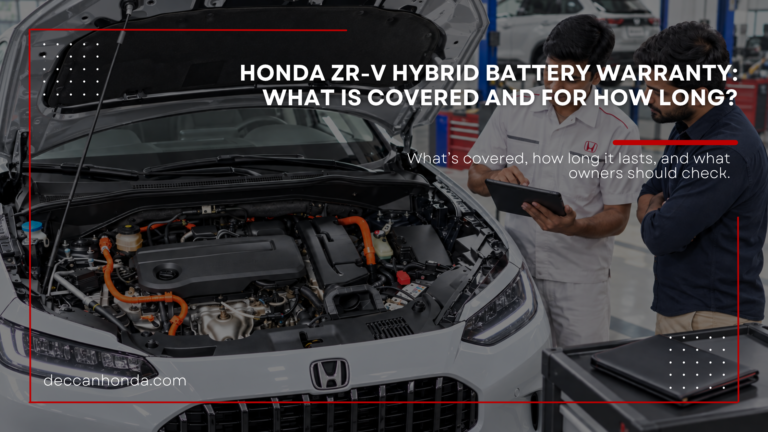
The India-spec Honda ZR-V e:HEV has an 8-year/160,000 km lithium-ion battery warranty. Learn how it differs from the hybrid-system and vehicle warranties, and what to verify before buying.
The Honda ZR-V e:HEV brings a strong-hybrid SUV into Honda’s India lineup. For many buyers, the first question after the test drive is practical: What happens if the hybrid battery develops a problem years later?
Honda’s published answer gives the headline periods. The ZR-V’s lithium-ion battery has an eight-year/160,000 km warranty, and its hybrid-system components have a separate five-year/100,000 km warranty. In each case, coverage ends when the time or distance limit is reached first. The vehicle also has a three-year standard warranty with unlimited kilometres.
Those are three different protections. Understanding which one applies to a concern is more useful than remembering only “eight-year hybrid warranty.”
Honda ZR-V coverage announced for India | Period or limit | The important distinction |
Lithium-ion hybrid battery | 8 years or 160,000 km, whichever comes first | Specific battery warranty |
Hybrid-system components | 5 years or 100,000 km, whichever comes first | Separate from the battery period |
Standard vehicle warranty | 3 years, unlimited kilometres | General vehicle warranty, subject to its terms |
Roadside assistance | 3 years complimentary | Assistance service, not a repair warranty |
Which battery is the eight-year warranty about?
The ZR-V is a self-charging strong hybrid. It uses a high-voltage lithium-ion battery as part of the e:HEV system, alongside a petrol engine and electric motors. The eight-year/160,000 km announcement refers to that lithium-ion hybrid battery.
Cars also use a conventional low-voltage battery for electrical functions. Do not assume the ZR-V’s ordinary 12-volt battery receives the same eight-year coverage. Ask the dealer to show you the separate terms that apply to it. The distinction matters because “battery” can mean two different items when discussing a hybrid.
Nor does the announcement say that every electrical or hybrid-related item automatically gets eight years. Honda states a different period for “hybrid system components.” The detailed list of covered parts should come from the India-spec warranty booklet supplied with the vehicle.
What does “whichever comes first” look like in real life?
Suppose a ZR-V reaches 160,000 km after seven years. The announced battery limit has been reached through mileage, even though eight calendar years have not passed. Or suppose it has travelled 90,000 km after eight years. The time limit has been reached, even though the mileage is below 160,000 km.
The same principle applies to the five-year/100,000 km hybrid-system warranty. A high-mileage owner could reach 100,000 km before five years. A low-mileage owner could reach five years first.
Before taking delivery, check the warranty document and registration paperwork for the exact start date and record the opening odometer reading. These details make it easier to understand the remaining coverage later, especially if the car changes owners.
What is covered if the battery develops a fault?
Here is where a headline is less precise than buyers may expect. Honda’s public ZR-V launch announcement identifies the lithium-ion battery and states the warranty duration. It does not, in that announcement, spell out every covered failure, diagnostic test, repair method, exclusion or battery-capacity threshold.
An owner should therefore not interpret “eight years” as a promise that Honda will replace the battery for any decline in displayed performance or fuel economy. Equally, a dashboard warning does not automatically mean that the battery pack itself has failed. A trained technician needs to diagnose the cause and assess the claim under the applicable terms.
Ask for the India-spec ZR-V warranty booklet before buying. Have the dealer identify the high-voltage battery section and explain:
- What defects or failures qualify for a claim?
- Is there a stated battery-health or capacity threshold?
- What inspections, service records or diagnostic procedures are required?
- If a repair is covered, is the remedy a component repair, battery repair or replacement?
- Which circumstances and types of damage are excluded?
Get any answer that materially affects your decision in writing or ask for the relevant page of the booklet. That lets you compare ownership terms without borrowing assumptions from another Honda model or another country’s warranty.
What about the five-year hybrid-system warranty?
Honda separately announces five years or 100,000 km for hybrid-system components. That protects a different category from the eight-year lithium-ion battery period. The public announcement does not name every eligible component, so avoid assuming that the engine, both electric motors, power electronics and every cable all receive the same coverage.
Ask the dealer for the component schedule or precise warranty wording. If a warning appears after three years but before five, the diagnostic result will matter: the applicable coverage depends on the diagnosed part and the written terms. The answer cannot be determined simply from the fact that the car is a hybrid.
The regular three-year unlimited-kilometre vehicle warranty is another layer. It does not erase the announced longer, mileage-limited periods for the hybrid battery and hybrid components.
Does extended warranty make the battery warranty longer?
Honda advertises extended-warranty options for the ZR-V up to seven years, as well as an Anytime Warranty programme with eligibility extending up to ten years/120,000 km. These are separate programmes with their own terms and eligibility conditions. Honda’s ZR-V launch announcement does not say that buying one extends the eight-year/160,000 km hybrid-battery warranty.
If you are offered an optional plan, ask for its price, start and end dates, covered-part list and exclusions. Specifically ask whether it adds anything to the battery or hybrid-system coverage already supplied with the car. Compare the written documents before paying for an upgrade.
Roadside assistance is separate too. Honda announced three years of complimentary roadside assistance for the ZR-V. It can help when you need support on the road; it is not an eight-year promise to repair a hybrid component.
What should an owner do if a warning appears?
If the instrument panel displays a hybrid or battery warning, follow the owner’s manual and contact an authorised Honda service centre. Note when the message appeared, photograph it if safe, and tell the advisor about any change in driving behaviour. Do not open or work on high-voltage components yourself.
Ask the service advisor for the diagnosis and applicable warranty category before authorising work. Keep the repair order, inspection findings and service records together. If a claim decision is unclear, request the relevant written warranty clause and an explanation of how it applies to the diagnosed fault.
Follow the ZR-V’s India-spec owner’s manual and warranty booklet rather than a service schedule for a City e:HEV or an overseas ZR-V.
The answer to take into the showroom
For the India-spec Honda ZR-V e:HEV, Honda has announced eight years/160,000 km for the lithium-ion hybrid battery, five years/100,000 km for hybrid-system components, and a three-year unlimited-kilometre standard vehicle warranty. The time or mileage cap ends the battery and hybrid-component coverage, whichever arrives first.
The published launch summary provides those periods; the warranty booklet determines the detailed claim conditions. Before buying, ask for that booklet and have the dealer walk you through the battery and hybrid-system sections.
If you are considering a ZR-V in Pune or Chhatrapati Sambhajinagar, contact Deccan Honda for a test drive and request the current India-spec warranty documents during your visit.