

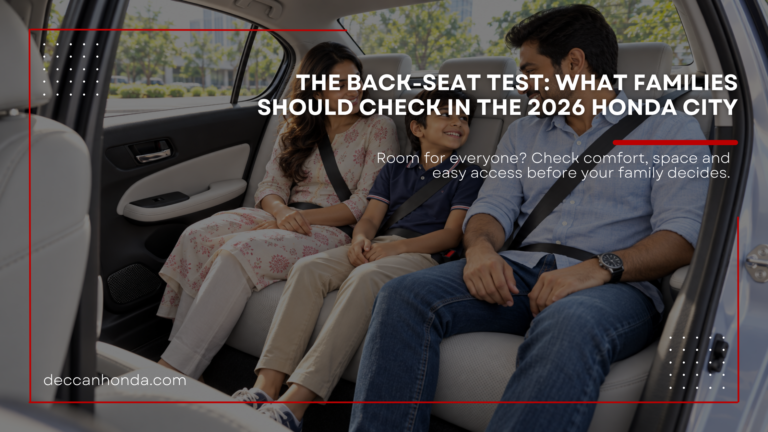
Thinking of buying the 2026 Honda City for your family? Use this back-seat test to check child-seat fit, comfort, safety, cooling and boot practicality before you book.
The driver gets the steering wheel. The front passenger gets the touchscreen. But on a family car, the people in the back seat often deliver the most honest review.
Will a child seat fit without pushing the front passenger forward? Can a grandparent get in comfortably? Will three people be happy on a weekend trip? These answers matter more than how roomy a car looks through the showroom window.
The 2026 Honda City brings updated styling and cabin equipment, but a brochure cannot tell you how it will work for your family. Take this back-seat test while parked, then ride in the rear.
Step 1: Set the front seats as you would on a real drive
The most common showroom mistake is testing the rear seat with both front seats pushed all the way forward. That creates legroom nobody will actually have once the family starts driving.
Ask the usual driver to set their seat, steering wheel and backrest to a natural position. Put the front passenger seat where it would be on a normal journey. Only then should your family sit behind them.
Check knee clearance and whether feet can slide under the front seats. Notice the backrest angle. Let taller family members try both outer positions. What matters is usable room with your own seating positions.
Quick test: Ask the person in front to get in and out without changing their seat setting. Does the rear passenger still have enough space?
Step 2: Try the real passenger arrangement
“Five seats” does not automatically mean that every combination of five passengers will feel equally comfortable. Try the arrangement you use most: two adults and a child, three adults, or two children with one adult between them.
Sit in the middle for a moment. Check shoulder space, foot position and how easy it is to reach and fasten the seat belt. Then try the outer seats. If an older parent travels with you, ask them to evaluate the seat cushion and how easy it is to stand up after the ride.
Close the doors and stay seated for several minutes. Picture a school run in traffic or a weekend outing. Does the arrangement suit your routine?
Step 3: Bring the child seat, if you use one
For parents, this is the most important practical check. Bring your actual child restraint to the showroom and ask for help locating the appropriate anchorages and top tether points in the exact car and variant you are considering. Follow the child-seat and vehicle manuals for compatibility and installation; a sales demonstration does not replace their instructions.
Once correctly fitted, check whether the front passenger still has a comfortable seating position. Can an adult buckle a child in without awkwardly leaning across the cabin? Can you lift a sleeping toddler through the door opening without bumping their head? Are the buckles accessible when the child seat is installed?
If you need two restraints, try both together. Check whether a third passenger can sit and belt up between them.
A useful question for the showroom: “Can I try my own child seat here before I decide on the car?”
Step 4: Check how everyone gets in and out
Open the rear door and try a normal entry. Ask a grandparent to do the same if they will ride often.
Look at the door opening, sill height and where a passenger can hold on while stepping out. If you routinely help a child, notice whether there is enough room for you beside the door. In a tight parking space, the door may not open fully, so ask whether you can safely check access with a smaller opening.
For someone with limited mobility, their own experience is the most useful measure.
Step 5: Give the rear passengers control of the comfort test
Turn on the air-conditioning and let the people in back report how they feel. The City’s rear seating area deserves its own assessment: notice airflow, cabin temperature and whether the vents can be directed comfortably. Test it with people seated in the positions they will usually occupy.
Honda announced rear USB-C charging ports as part of the 2026 City update. Find their position in the variant you are examining and check whether your family’s cables reach without stretching across someone’s legs. Also inspect door pockets, seatback storage and cupholders for the bottles and small items you actually bring.
If a centre armrest or sunshade matters, check availability on your chosen variant. An armrest folded down changes the middle passenger’s experience.
Step 6: Put safety questions into practical terms
Ask the consultant to show you each rear seat belt and head restraint, then have every intended passenger sit down and fasten a belt. For children, use an age- and size-appropriate restraint as directed by its manufacturer. Do not assume that a child can safely use an adult belt simply because they can make it click.
The 2026 City range includes Honda SENSING driver-assistance technology, with equipment and functions varying by powertrain and grade. Ask for a demonstration of the features on the exact version you plan to buy. Driver assistance supports an attentive driver; it does not change the need for correct restraint use in the rear.
Before finalising, compare the current variant brochure and written quotation. A showroom display car may have equipment that the version you choose does not
Step 7: Ride in the back while someone else drives
Now take the test beyond the showroom. Let the person who normally drives take the wheel while you sit where your family would sit. A short route with ordinary traffic and a few uneven patches can reveal more than a stationary inspection.
Can you speak to the front passenger without raising your voice? How does the seat feel over a speed breaker? Does the cabin settle comfortably after a bump? Can a rear passenger see outside without feeling enclosed? Ask everyone for their view before the driver shares theirs; otherwise, the driver’s enthusiasm can colour the whole discussion.
If the route is too short, ask for a longer test drive.
Step 8: Do the luggage test
Family comfort continues beyond the rear bench. Honda lists a 506-litre boot for the City petrol model, but the shape of your luggage matters as much as the stated capacity. Open the boot and look at its opening and loading height.
Could you place a folded stroller, two cabin bags and the usual smaller bags inside? If those items are central to your routine, bring them to check fit, with the showroom’s permission. Ask whether the petrol and e:HEV versions differ in luggage space before assuming the same packing plan works for both.
Check whether you can load and retrieve items comfortably.
Let the back seat help you decide
The 2026 Honda City may catch your attention from the driver’s seat. The back-seat test tells you whether it fits the people who will share every journey. Bring your family, set the car up as you would use it, and check the exact variant before making a decision.
Ready to try it? Book a Honda City test drive with Deccan Honda in Dhankawadi or Magarpatta, Pune, or Waluj, Chhatrapati Sambhajinagar. Tell the team you want time to check the rear seat and bring the family members who will use it most.
Book a test drive: https://deccanhonda.com/test-drive/