

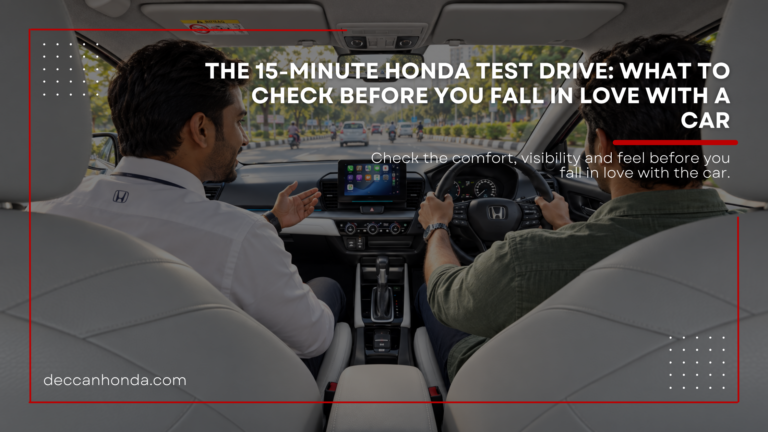
A Honda test drive is more than a quick spin. Use this 15-minute checklist to assess comfort, visibility, handling, parking and the right variant for your daily life.
The car looks brilliant under the showroom lights. You like the colour, the seats feel inviting, and you can already picture it in your parking space. Then the test drive begins—and suddenly you have just a few minutes to decide whether this Honda actually fits your life.
That is where a little planning helps. A test drive is not a driving exam or a chance to see how fast a car can go. It is a short preview of the commute, family trips and tight parking spots you will experience after the excitement of delivery day fades.
Here is a simple 15-minute plan. Use it to compare the Honda Amaze, City, Elevate or another model you are considering, and ask for more time if one drive does not answer your questions.
Before you start: make the drive yours
When booking, request the model, transmission and variant closest to the one you intend to buy. Equipment and driving feel may differ between versions. Tell the sales consultant what your usual journeys look like: slow city traffic, a highway commute, narrow lanes, steep parking ramps or frequent trips with family.
Ask for a route with a mix of ordinary roads. Bring the family member who will drive regularly. If you have a child seat or other essential item, ask whether you can check its fit while parked.
Keep your phone away while driving. A passenger can take notes, or you can use the scorecard at the end immediately after the drive.
Minutes 0–2: find your natural driving position
Do not pull away the moment you sit down. Adjust the seat, steering wheel and mirrors until the pedals are comfortable to reach and you can see clearly ahead. Check whether your knees have room, your arms feel relaxed and the headrest sits at a useful height.
Now look around. Can you judge the car’s front corners? Do pillars block too much of your view when you turn? Are the mirrors easy to use? Try the indicator, climate controls and commonly used buttons while parked. A feature that looks impressive in a brochure should also be simple to operate on an ordinary Tuesday.
If someone else will drive regularly, let them repeat this setup later.
Minutes 2–5: test the traffic you actually face
Start at a calm pace. Notice how smoothly the car moves away, how easy it is to control at low speed and whether the steering feels manageable through turns. In a manual, pay attention to clutch effort and the ease of changing gears. In an automatic, see how naturally it responds when you ease off the brake and move with traffic.
This is especially useful for a Honda test drive in Pune or Chhatrapati Sambhajinagar, where your daily experience may include signals, two-wheelers, speed breakers and busy junctions. You do not need to create a difficult situation to evaluate the car. Use the normal traffic on an approved route and drive responsibly.
Ask yourself: Would I be comfortable doing this journey five days a week?
Minutes 5–8: listen and feel on a mixed stretch
When the route and traffic allow, drive at a steady, legal speed. Is the cabin quiet enough for an easy conversation? Notice road and tyre noise, especially when the surface changes. Feel what happens over a typical speed breaker or uneven patch: does the car settle in a way you like?
Then try a gentle, normal acceleration. You are checking whether the response suits your driving style, not measuring a performance figure. If you routinely carry passengers or luggage, ask how the car may feel when loaded and consider a longer second drive with your usual passengers.
Check whether the air-conditioning makes the cabin comfortable and airflow reaches the seats your family will use.
Minutes 8–11: check confidence, not just features
At a safe, normal junction, notice how easily you can look for approaching vehicles, pedestrians and two-wheelers. Check the side mirrors and your over-the-shoulder view. If the test car has a camera or driver assistance feature, ask the consultant to explain what it does and which variant includes it. Use it as an aid while continuing your own observations.
Pay attention to braking feel on a normal stop. Does the pedal respond predictably? Are you comfortable judging the car’s width through a narrow stretch? If you are moving from a smaller car to an SUV, this may take a little time; that is a useful observation, not necessarily a reason to rule it out.
Some assistance features need particular road conditions. Never test them by creating a hazard.
Minutes 11–13: do the parking test
If the route permits, ask to park in a suitable, legal space. This is often the most revealing part of the drive. Can you judge the rear corners? Do you feel confident reversing slowly and checking the mirrors? If a reversing camera or parking sensors are fitted, see whether the display and alerts are clear to you.
Think about your parking spot at home or work. Is the entrance narrow? Is there a ramp or tight turn? Ask whether a longer drive near that location is possible
Minutes 13–15: swap seats and inspect real-life space
Once the car is safely parked, sit in the rear seat. Check knee room and headroom with the front seat set for your normal driving position. Can an older family member get in and out comfortably? Is there space for the people who will actually travel with you?
Open the boot and imagine loading your regular bags rather than guessing from a capacity number. Look at the opening, the height you must lift items and how easy it is to reach the back. Check storage for phones, bottles and smaller objects you carry every day.
Finally, confirm the exact variant you drove. Write down the features you liked and ask which of them are included in the version on your quotation.
The 60-second scorecard: decide after the excitement settles
Give each item a score from 1 to 5, where 1 means “needs another look” and 5 means “fits me well”:
What matters | Score / 5 | One quick note |
Driving position and visibility | ||
Comfort in traffic | ||
Ride and cabin noise | ||
Ease of parking | ||
Rear-seat and boot practicality |
The total is useful, but your notes matter more. “Easy to park, rear seat too tight for Dad” tells you more than 21 out of 25. If you are comparing two Honda models, drive both on a similar route and fill in a separate scorecard immediately afterward.
Three questions to ask before you leave
- Did I drive the version I would buy? If not, request a drive or a parked walkthrough of the exact variant and transmission. Verify the feature list against the current brochure and quotation.
- What is the complete on-road price? Ask for a written breakdown covering the vehicle, registration, insurance, accessories and any applicable offers. Separate optional items so you can compare quotations clearly.
- Do I need another drive? Fifteen minutes can reveal a lot, but it cannot reproduce every road, weather condition or family trip. If comfort, parking or highway behaviour still feels uncertain, book more time before making a decision.
Ready to take the driver's seat?
The best Honda for you is the one that continues to make sense after the first impression. Use these 15 minutes to test the moments you will live with most: the morning commute, the parking manoeuvre, the passenger seat conversation and the bags in the boot.
If you are looking for a Honda car test drive in Pune or Chhatrapati Sambhajinagar, book your preferred model with Deccan Honda. You can request a drive at Dhankawadi or Magarpatta in Pune, or at the Waluj showroom in Chhatrapati Sambhajinagar. Tell the team what you want to check, and turn a short drive into a confident decision.
Book your test drive: https://deccanhonda.com/test-drive/