

India’s premium SUV market is entering a new phase. Buyers are no longer looking only for a large body, powerful engine or luxury badge. They increasingly want advanced technology, lower running costs, refined performance and a more sustainable driving experience.
Arriving at exactly this moment is the Honda ZR-V e:HEV, a premium sports hybrid SUV imported directly from Japan.
Priced at an introductory ₹47.99 lakh, ex-showroom, the ZR-V has become Honda’s new flagship model in India. It is offered as a fully imported Completely Built Unit, or CBU, and combines Japanese engineering with Honda’s advanced 2.0-litre e:HEV strong-hybrid technology.
The ZR-V may not become a mass-market bestseller because of its premium price and limited availability. However, it could still influence what Indian customers expect from future premium hybrid SUVs.
Why Is the ZR-V’s India Launch Important?
The ZR-V arrives at a time when alternative-fuel vehicles are gaining serious attention in India.
In June 2026, electric, hybrid and CNG vehicles together accounted for 40.35% of India’s passenger-vehicle retail sales. Strong and mild hybrids represented approximately 8.3% of passenger-vehicle sales during the month, showing that buyers are increasingly considering electrified vehicles alongside conventional petrol and diesel models.
This creates an important opportunity for the Honda ZR-V hybrid.
It offers many of the efficiency and low-speed refinement benefits associated with electrified cars, but it does not require external charging. For premium buyers who are interested in electric mobility but remain concerned about charging availability or driving range, a self-charging strong hybrid can provide a practical alternative
Japan-Built Exclusivity Creates a Different Appeal
The Honda ZR-V sold in India is manufactured in Japan and imported as a CBU.
Being fully imported makes it more expensive than a locally manufactured SUV, but it also gives the ZR-V a sense of exclusivity. It allows Indian customers to experience a global Honda product in a specification closely aligned with international markets.
For premium buyers, the appeal is not simply that the vehicle comes from Japan. It is the combination of:
- Global Honda engineering
- Sophisticated hybrid technology
- Premium fit and finish
- Limited availability
- Distinctive crossover styling
- An ownership experience different from mainstream SUVs
The ZR-V is therefore positioned less as a high-volume family SUV and more as a brand-building flagship for Honda.
A Hybrid System That Balances Performance and Efficiency
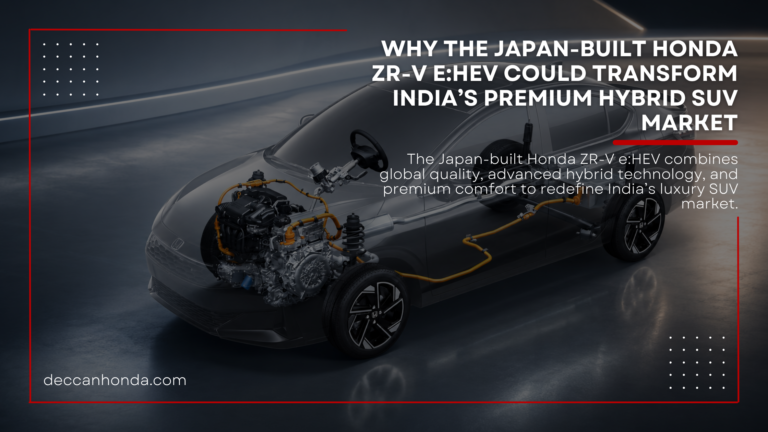
At the centre of the ZR-V is Honda’s 2.0-litre sports hybrid e:HEV powertrain, paired with an advanced e-CVT.
The intelligent system operates through three primary driving modes:
- EV Drive: The electric motor powers the vehicle using battery energy.
- Hybrid Drive: The petrol engine generates electricity while the motor drives the wheels.
- Engine Drive: The petrol engine can directly power the wheels during suitable high-speed conditions.
The transition between these modes happens automatically according to speed, power demand and driving conditions.
Honda claims a fuel efficiency of 22.8 km/l, an impressive figure for a premium SUV with strong performance potential.
This balance could influence the premium market because buyers may no longer feel that they must choose between performance and efficiency. The ZR-V demonstrates that a hybrid SUV can deliver quick responses, smooth electric-style acceleration and lower fuel consumption in one package.
No Charging Stops or Range Anxiety
One of the biggest advantages of a strong-hybrid vehicle is that it does not need to be plugged into an external charger.
The ZR-V’s battery receives energy from the petrol engine and regenerative braking system. This allows drivers to experience electric-motor assistance without planning journeys around charging stations.
For Indian customers, this can be especially valuable during:
- Daily urban commuting
- Long highway journeys
- Intercity travel
- Apartment living without private charging
- Travel through areas with limited charging infrastructure
The ZR-V could therefore become an attractive transition vehicle for buyers who want electrified performance but are not ready to move to a fully electric SUV.
A Sportier Alternative to Traditional Premium SUVs
Many premium SUVs focus on an upright, boxy and commanding appearance. The Honda ZR-V takes a different route.
It combines the raised seating position of an SUV with a lower, sportier crossover profile. Its vertical front grille, slim LED headlamps, integrated LED daytime-running lights, sequential indicators and 18-inch diamond-cut alloy wheels give it a distinctive road presence
This design may appeal to customers who want an SUV’s practicality without the visual heaviness of a traditional full-size model.
The ZR-V’s positioning could encourage more manufacturers to explore premium crossovers that prioritise driving dynamics, efficiency and urban usability rather than simply increasing vehicle size.
A Cabin Designed for Premium Buyers
The ZR-V’s interior combines a clean dashboard design with modern technology and practical physical controls.
Key cabin and technology highlights include:
- Nine-inch touchscreen infotainment system
- Wireless Apple CarPlay and Android Auto
- 10.2-inch digital instrument display
- Premium Bose audio system
- Wireless smartphone charging
- Powered front seats
- Driver-seat memory function
- Dual-zone climate control
- Ambient interior lighting
- Gesture-controlled powered tailgate
Honda’s decision to offer the ZR-V as a single, well-equipped variant allows customers to experience its main premium features without choosing between several trim levels.
Honda SENSING Raises Safety Expectations
Premium positioning now depends as much on safety technology as it does on comfort and performance.
The ZR-V is equipped with Honda SENSING, which includes advanced driver-assistance features such as:
- Collision Mitigation Braking System
- Adaptive Cruise Control with Low-Speed Follow
- Lane Keeping Assist System
- Road Departure Mitigation
- Auto High Beam
- Lead Car Departure Notification
Additional safety equipment includes eight airbags, a 360-degree surround-view camera, front and rear parking sensors, a driver-attention monitor, Hill Descent Control, Vehicle Stability Assist, Hill Start Assist and ISOFIX child-seat mounts. These technologies do not replace attentive driving, but their presence could raise customer expectations across the premium hybrid SUV segment.
Could the ZR-V Change the Market Despite Its Price?
At ₹47.99 lakh, the ZR-V is significantly more expensive than Honda’s mainstream Indian models. Its CBU status also means it competes against larger premium SUVs and entry-level vehicles from luxury brands.
Therefore, its market impact may not be measured only by sales volume.
The ZR-V could transform the segment by:
Making Strong Hybrids More Desirable
It presents hybrid technology as a performance and premium feature rather than simply a fuel-saving solution.
Creating an Alternative to Diesel SUVs
Customers seeking strong torque, highway comfort and reasonable running costs may begin considering premium hybrids instead of automatically choosing diesel.
Bridging the Gap Between Petrol and Electric Cars
The self-charging system offers electrified driving without requiring customers to change their refuelling habits.
Encouraging More Premium Hybrid Launches
A positive response to the ZR-V could encourage Honda and competing manufacturers to introduce additional strong-hybrid SUVs in India.
Redefining Premium Honda Ownership
The ZR-V gives Honda customers a flagship upgrade option above the Elevate, City and City e:HEV.
Is the Honda ZR-V Right for Every Premium SUV Buyer?
The ZR-V may not suit buyers who prioritise seven seats, all-wheel drive, the largest possible cabin or a traditional luxury badge.
However, it could be a compelling choice for customers who value:
- Japanese engineering
- Strong-hybrid efficiency
- Smooth and responsive performance
- Premium technology
- Advanced safety features
- Five-seat comfort
- Exclusivity
- Honda’s reputation for refinement
Its greatest strength is that it does not attempt to imitate every other premium SUV. Instead, it offers a distinct combination of crossover agility, intelligent hybrid power and everyday usability.
A Significant New Chapter for Honda India
The Japan-built Honda ZR-V e:HEV represents more than the arrival of another expensive SUV.
It demonstrates how hybrid technology can combine electric smoothness, petrol convenience, strong performance and impressive claimed efficiency. At the same time, its CBU status, premium equipment and limited availability give Honda a new flagship identity in India.
The ZR-V may not transform the premium SUV market overnight. However, it could influence buyer expectations and encourage more manufacturers to treat strong hybrids as exciting premium vehicles rather than temporary alternatives to electric cars.
Visit Deccan Honda in Pune to explore the Honda ZR-V e:HEV, understand its intelligent hybrid technology and enquire about availability or a test drive.
Frequently Asked Questions
1. Is the Honda ZR-V manufactured in India?
No. The Honda ZR-V e:HEV is manufactured in Japan and imported into India as a Completely Built Unit.
2. What is the Honda ZR-V price in India?
The Honda ZR-V has been introduced at ₹47.99 lakh, ex-showroom. The on-road price varies according to the city, registration charges, insurance and applicable taxes.
- Does the Honda ZR-V need external charging?
No. The ZR-V is a self-charging strong hybrid. Its battery is charged through the petrol engine and regenerative braking system.
4. What is the claimed mileage of the Honda ZR-V?
Honda claims a fuel efficiency of 22.8 km/l. Actual mileage may vary depending on traffic, driving style, road conditions and vehicle load.
5. What are the main competitors of the Honda ZR-V?
The ZR-V competes in the premium SUV space with models such as the Skoda Kodiaq, Volkswagen Tiguan R-Line and Nissan X-Trail, while its price also places it near selected entry-level luxury SUVs.