

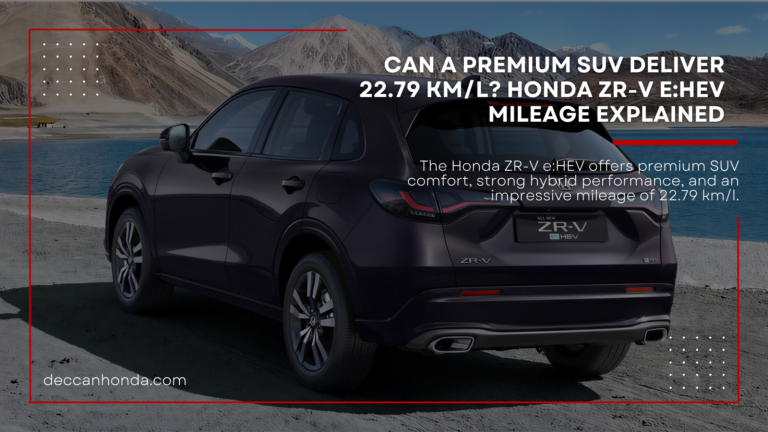
Premium SUVs are usually associated with powerful engines, spacious cabins and high fuel consumption. The Honda ZR-V e:HEV, however, challenges that expectation by combining strong performance with an officially claimed fuel efficiency of 22.79 km/l, rounded to 22.8 km/l on Honda’s website.
That is an impressive figure for a premium SUV powered by a 2.0-litre engine and capable of producing 184 PS and 315 Nm of torque. But how does a vehicle of this size and performance achieve such strong mileage?
The answer lies in Honda’s intelligent e: HEV strong-hybrid technology, which automatically selects the most efficient source of power for different driving conditions.
What Is the Honda ZR-V’s Claimed Mileage?
Honda officially states that the ZR-V delivers a fuel efficiency of 22.8 km/l. The more precise figure mentioned in Honda’s India launch information is 22.79 km/l.
This is a claimed, test-cycle figure. Actual mileage can vary according to:
- Traffic conditions
- Driving style
- Average speed
- Road and weather conditions
- Air-conditioning use
- Passenger and luggage load
- Tyre pressure
- Maintenance condition
The ZR-V may perform particularly efficiently in urban traffic because its electric motor can handle many low-speed driving situations without continuously relying on the petrol engine.
Engineering Innovations Behind the 22.79 km/l Fuel Economy
The Honda ZR-V uses a 2.0-litre Gasoline Direct Injection engine, two electric motors and an advanced e-CVT transmission.
Unlike a mild-hybrid system that provides only limited electrical assistance, Honda’s e:HEV system can use the electric motor as the primary source of propulsion in several driving situations.
The vehicle intelligently switches between three operating modes:
- EV Drive
- Hybrid Drive
- Engine Drive
It also recovers energy through regenerative braking. The driver does not need to manually select between these power sources because the system manages them automatically.
1. EV Drive for Quiet, Efficient Movement
During smooth starts and certain low-speed situations, the ZR-V can operate using battery power while the petrol engine remains switched off.
The electric motor drives the wheels, creating a quiet and responsive experience similar to an electric vehicle. Honda explains that the vehicle can start using only motor power, allowing it to move without consuming petrol during that phase.
This is especially useful in:
- Slow-moving city traffic
- Parking areas
- Short low-speed movements
- Stop-and-go conditions
- Gentle acceleration
Because the engine does not need to remain active every time the car moves, unnecessary fuel consumption can be reduced.
However, EV Drive is not the same as the operation of a fully electric vehicle. Its availability depends on battery charge, speed, acceleration demand and other operating conditions.
2. Hybrid Drive for Everyday Performance
When additional power is required, the petrol engine starts working, but it does not always drive the wheels directly.
In Hybrid Drive, the engine can generate electricity while the electric motor continues to propel the vehicle. This allows the petrol engine to operate within a more efficient range instead of constantly changing its output according to every press of the accelerator.
This arrangement helps the ZR-V deliver:
- Smooth acceleration
- Quick electric-motor response
- Reduced engine strain
- Efficient urban performance
- Strong overtaking capability
The electric motor’s immediate torque also means the SUV can respond quickly without requiring the engine to work aggressively during every acceleration.
3. Engine Drive for Efficient Highway Cruising
At suitable cruising speeds, the petrol engine can directly drive the wheels through a lock-up mechanism.
This is useful on highways, where direct engine power may be more efficient than repeatedly converting petrol energy into electricity and then using that electricity to run the motor.
The system constantly evaluates factors such as speed, battery charge and power demand before selecting the most suitable operating mode.
This automatic switching helps the ZR-V balance efficiency across both city and highway conditions.
4. Regenerative Braking Recovers Energy
In a conventional petrol car, much of the vehicle’s moving energy is lost as heat during braking.
The ZR-V’s regenerative braking system captures part of that energy and converts it into electricity. The recovered energy is stored in the hybrid battery and can later be used to power the electric motor.
Honda also equips the ZR-V with a metallic deceleration selector, allowing the driver to adjust the level of deceleration in suitable situations.
This process is particularly helpful during:
- Frequent urban braking
- Slowing for traffic
- Descending slopes
- Approaching junctions
- Stop-and-go journeys
The vehicle therefore reuses energy that would otherwise have been wasted.
Does the Honda ZR-V Need External Charging?
No. The Honda ZR-V is a self-charging strong-hybrid SUV.
Its battery receives energy from the petrol engine and regenerative braking system. Owners do not need to plug the vehicle into an external charging point.
This gives customers some benefits of electric driving without requiring:
- A home charging installation
- Public charging stops
- Charging-route planning
- Long battery-charging periods
Drivers can refuel the ZR-V like a regular petrol car while the hybrid system manages battery charging automatically.
Is High Mileage Achieved by Sacrificing Performance?
One of the most impressive aspects of the Honda ZR-V e: HEV is that efficiency does not come at the cost of slow performance.
Its hybrid system produces up to 184 PS and 315 Nm, while Honda’s official launch information lists a 0–100 km/h acceleration time of 7.9 seconds.
The electric motor provides immediate torque, helping the SUV feel responsive during:
- City acceleration
- Highway overtaking
- Merging into fast traffic
- Climbing inclines
- Sporty driving
Drivers can also select between ECON, Normal and Sport modes according to their preferences.
- ECON Mode
Supports smoother responses and efficiency-focused driving.
- Normal Mode
Balances performance, comfort and everyday fuel economy.
- Sport Mode
Provides a sharper response for drivers seeking a more engaging experience.
Using Sport mode frequently or accelerating aggressively may reduce real-world mileage, while smoother inputs can help the hybrid system operate more efficiently.
Why Hybrid SUVs Can Perform Well in City Traffic
Traditional petrol vehicles often consume more fuel in congested traffic because the engine continues running during frequent starts, stops and low-speed movement.
A strong hybrid can reduce this disadvantage by using:
- Electric-only movement where conditions allow
- Automatic engine shut-off
- Regenerative braking
- Electric-motor assistance
- Intelligent energy management
As a result, city traffic does not always affect a strong hybrid in the same way it affects a conventional petrol SUV.
The final mileage will still depend on traffic intensity and driving behaviour, but the ZR-V’s hybrid system is designed to make frequent stopping and starting more efficient.
How to Get Better Mileage from Your Honda ZR-V
Even advanced hybrid technology benefits from sensible driving habits.
To improve fuel efficiency:
- Maintain a consistent speed where possible
- Anticipate traffic and brake progressively
- Use ECON mode for relaxed daily driving
- Avoid unnecessary idling
- Maintain the recommended tyre pressure
- Remove unnecessary weight from the vehicle
- Follow the recommended service schedule
- Avoid excessive air-conditioning settings
- Use the digital efficiency information to improve driving habits
Heavy acceleration forces the powertrain to provide maximum output, while smoother acceleration gives the vehicle more opportunities to use its electric motor efficiently.
Is 22.79 km/l Realistic for Every Driver?
The 22.79 km/l figure should be viewed as a certified or manufacturer-claimed efficiency benchmark, not a guaranteed result for every journey.
A driver travelling through moderate traffic with smooth acceleration may experience different mileage from someone driving at high speeds with heavy acceleration and a fully loaded cabin.
Real-world fuel efficiency can also change between:
- Short and long journeys
- City and highway routes
- Summer and monsoon conditions
- Light and heavy traffic
- ECON and Sport mode use
The most useful way to understand the ZR-V’s efficiency is to take a test drive and evaluate how its hybrid system performs in conditions similar to your everyday journeys.
A Premium SUV That Changes Mileage Expectations
The Honda ZR-V e: HEV mileage is significant because it demonstrates that premium performance and fuel efficiency do not need to be opposites.
Its 2.0-litre hybrid powertrain provides the responsiveness expected from a premium SUV, while EV Drive, Hybrid Drive, Engine Drive and regenerative braking help reduce unnecessary fuel consumption.
The claimed 22.79 km/l figure may vary in real-world use, but the technology behind it gives the ZR-V a compelling advantage for buyers who want:
- Premium comfort
- Strong acceleration
- Lower fuel consumption
- Electric-style refinement
- No external charging requirement
- Everyday city and highway usability
Visit Deccan Honda in Pune to experience the Honda ZR-V e: HEV, understand its intelligent hybrid system.
Frequently Asked Questions
1. What is the mileage of the Honda ZR-V e:HEV?
Honda lists the ZR-V’s claimed fuel efficiency as 22.79 km/l, rounded to 22.8 km/l on its official product pages. Actual mileage may vary according to driving and road conditions.
2. Does the Honda ZR-V run entirely on electricity?
The ZR-V can use electric-only propulsion in certain situations, but it is not a fully electric vehicle. Its intelligent hybrid system automatically switches between EV Drive, Hybrid Drive and Engine Drive.
3. Does the Honda ZR-V need to be plugged in?
No. It is a self-charging hybrid. The petrol engine and regenerative braking system recharge the hybrid battery while the vehicle is being driven.
4. Is the Honda ZR-V suitable for highway driving?
Yes. Its 184 PS hybrid system, 315 Nm of torque and Engine Drive operation support smooth, responsive highway performance.
5. Which driving mode provides the best mileage?
ECON mode is designed to support efficient driving responses. However, actual mileage depends more broadly on acceleration, speed, traffic, road conditions and vehicle load.