

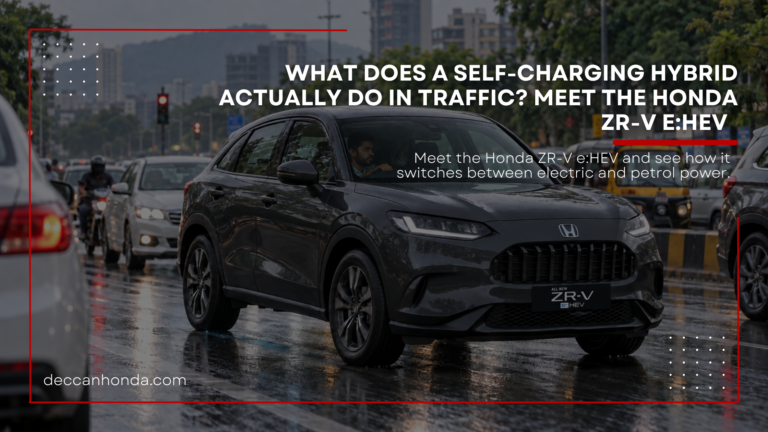
Curious how the Honda ZR-V e:HEV works in stop-start traffic? Follow one everyday commute to understand EV Drive, Hybrid Drive, regenerative braking and what “self-charging” really means.
You are waiting at a signal. The line moves a few metres, stops, and moves again. In the Honda ZR-V e:HEV, what powers the car can change throughout that journey: sometimes an electric motor drives the wheels, sometimes the petrol engine generates electricity for that motor, and sometimes the engine drives the wheels directly.
You do not need to choose between those operating modes. The ZR-V’s hybrid system switches automatically. So what does that mean on the road, especially in the stop-start traffic you meet in Pune? Let’s follow a typical commute.
First, what does “self-charging” mean?
The ZR-V e:HEV is a strong hybrid with a petrol engine, two electric motors and a battery. “Self-charging” means you do not connect it to an external charger. The car manages its battery using energy generated by the petrol engine and energy recovered while slowing down.
It does not mean the car creates free energy or runs indefinitely without petrol. You fill it with petrol as usual. The system can use electrical energy where it is useful, recover some energy during deceleration, and choose how to propel the car as conditions change.
Think of the battery as an energy buffer rather than a large plug-in EV battery. The system charges and uses it repeatedly during a journey. The driver selects Drive and uses the accelerator and brake in the normal way.
Scene 1: The light turns green
At a gentle start, the ZR-V may move using EV Drive. In this mode, its electric traction motor turns the wheels using battery power. The petrol engine does not have to drive the car at that moment. This can make the first few metres feel smooth and quiet.
The key word is may. Battery charge, temperature, climate-control demand and how hard you press the accelerator can affect what the system chooses. EV Drive is an automatic operating mode, not a promise that every slow-moving stretch will be covered on electricity alone.
That is the right expectation to take into a test drive. Notice how the car pulls away gently, but let the system make its own decisions.
Scene 2: Traffic opens and you accelerate
The gap ahead grows. You press the accelerator more firmly to join the flow. The ZR-V can switch to Hybrid Drive: the petrol engine runs a generator, which supplies electricity to the traction motor driving the wheels. The battery can also contribute according to demand.
Here, the petrol and electrical parts of the system work together. The engine may be running even while an electric motor provides the drive at the wheels. “Engine on” does not always mean “engine directly powering the wheels.”
Honda pairs the India-spec ZR-V’s 2.0-litre petrol engine with a dual-motor e:HEV system and an e-CVT. The system is designed to respond as your speed changes without asking you to manage a clutch or manually switch power sources
Scene 3: You settle into a steady stretch
On a suitable steady-speed section, the system may select Engine Drive. In this mode, the petrol engine can drive the wheels directly. At other speeds or loads, electric or hybrid operation may be more appropriate.
There is no single mode for an entire commute. What works while crawling away from a signal may differ from what works while cruising. The ZR-V changes modes as driving conditions change; you concentrate on the road.
Its ECON, Normal and Sport settings let you choose a driving response. During a test drive, the useful question is how naturally the vehicle responds in the conditions you encounter most often.
Scene 4: The next signal turns red
You lift off the accelerator and slow down. The ZR-V can use regenerative braking: its electric motor acts as a generator and sends recovered energy back to the battery. The car also has conventional braking for the stopping power required.
Regeneration does not recover every unit of energy used to accelerate. It gives the system an opportunity to reclaim some energy during deceleration.
The ZR-V also has deceleration selector paddles that can change the slowing sensation and level of regenerative deceleration. Ask the sales consultant to demonstrate them.
Now the light changes again, and the cycle repeats. Starts, gentle acceleration and slowing give the hybrid system frequent opportunities to switch modes and recover energy.
What will you notice from the driver’s seat?
Most drivers will notice the experience before the engineering. Pulling away can feel quiet and smooth. The transitions happen automatically. You may hear the engine start when the battery needs charging or when you ask for more power, even if you are travelling slowly.
There is no need to try to “force” EV Drive by watching a display instead of the road. If the test car shows energy flow, examine it while safely parked or let a passenger observe. It explains what the car is doing; it is not a score you must maximise at every signal.
During a test drive, pay attention to three things: how naturally the ZR-V moves in traffic, how it responds when you need to accelerate, and how comfortable you feel when slowing to a stop. Those impressions tell you more about everyday ownership than a run on an empty road alone.
Does self-charging mean lower fuel bills?
Honda lists a certified fuel-efficiency figure of 22.8 km/l for the India-spec ZR-V e:HEV. That is a standardised test figure, not a guarantee for every commute. Actual results depend on traffic, driving style, speed, terrain, air-conditioning use and other conditions.
The system can use recovered energy and choose among its operating modes, but it still consumes petrol. A short trip with heavy air-conditioning or repeated hard acceleration may produce a different result from a longer, smoother drive. If running cost matters to you, compare your likely annual kilometres and fuel expenses instead of treating one certified figure as your result on every journey.
There is also no charging-station planning for this hybrid. That may appeal to someone who wants electric-motor assistance in traffic while keeping a familiar petrol-refuelling routine.
Three questions to ask during your ZR-V test drive
- Can we include some normal traffic? A city section lets you experience the starts, stops and changes of pace you will meet regularly.
- Can you explain the power-flow display and deceleration paddles? A short demonstration makes the technology easier to understand. Keep your attention on the road while driving.
- What will my on-road cost and ownership coverage be? Ask for a written local quotation and current warranty terms. Honda states an eight-year/160,000 km warranty for the lithium-ion battery and a five-year/100,000 km warranty for hybrid system components, subject to the stated limits.
Experience the explanation, not just the specification
The simplest answer to “What does a self-charging hybrid do in traffic?” is this: it chooses how to use its petrol engine and electric motors while recovering some energy as you slow down. You drive it like an automatic petrol car; the powertrain does the switching.
If you are considering a hybrid SUV in Pune or Chhatrapati Sambhajinagar, request a ZR-V test drive with Deccan Honda and ask for a route that includes the traffic you actually face